
When deciding between Tokyo and Osaka for real estate investment, the choice often boils down to your priorities: steady long-term growth or higher short-term returns. Here’s a quick breakdown:
- Tokyo: Offers lower rental yields (3.59% in Q3 2025) but promises stable demand and long-term property value growth. Higher property prices and rents reflect its status as Japan’s economic hub.
- Osaka: Provides higher rental yields (4.26% in Q3 2025) due to more affordable property prices. Upcoming developments like the 2030 Integrated Resort project could further boost its appeal.
Quick Comparison
| Metric | Tokyo | Osaka |
|---|---|---|
| Average Rental Yield | 3.59% | 4.26% |
| Average Monthly Rent | ¥73,000–¥78,000 ($492–$530) | ¥62,000 ($418) |
| Property Prices | Higher (100%) | 30–40% lower |
| Occupancy Rate (2025) | 96.6% | Strong but slightly lower |
| Key Developments | Stable growth | Expo 2025, 2030 projects |
If you value immediate cash flow, Osaka’s higher yields and lower entry costs make it attractive. For long-term stability and appreciation, Tokyo is the safer bet.
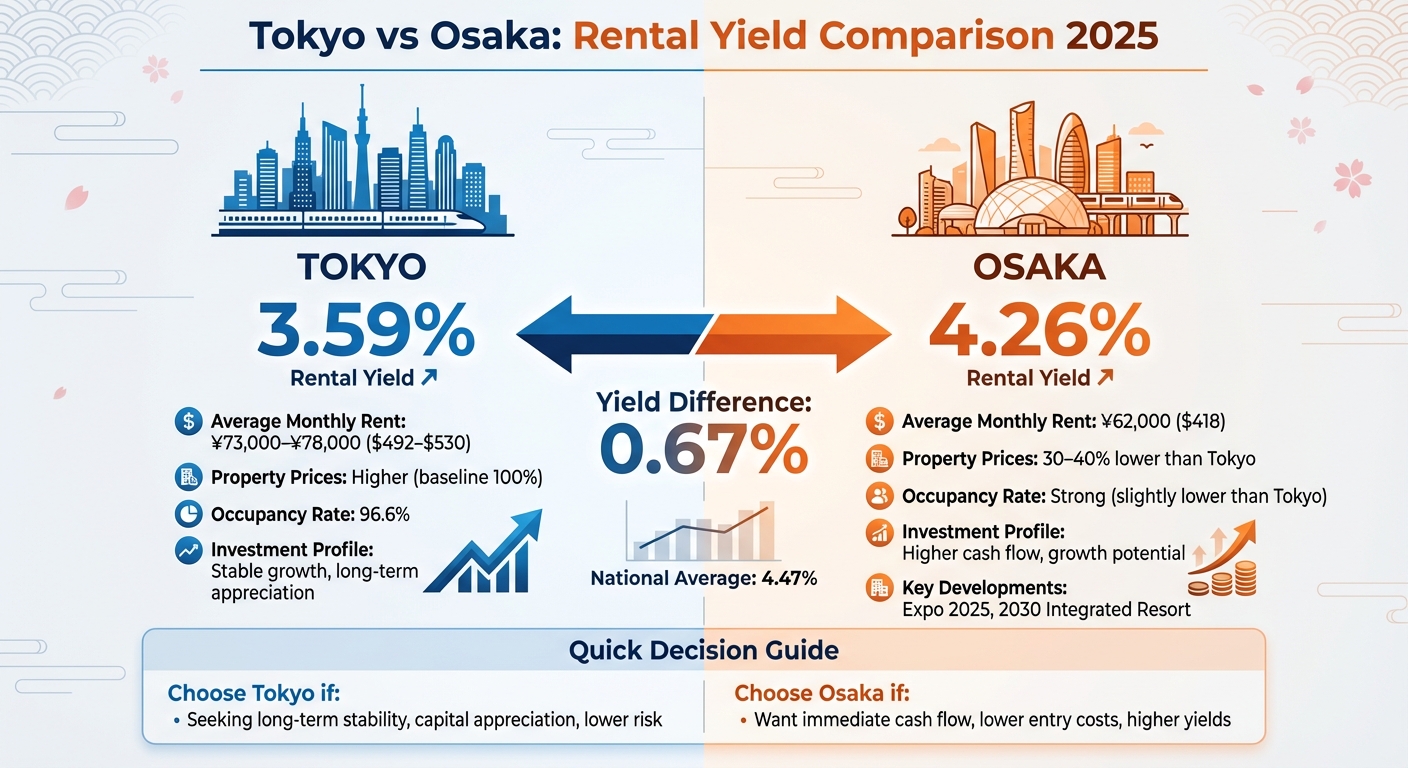
Tokyo vs Osaka Rental Yields Comparison 2025
Average Rental Yields: Tokyo vs Osaka
Tokyo Rental Yields
In 2025, Tokyo’s gross rental yield stands at 3.59%, falling below the national average of 4.47%. This lower yield is largely due to higher property prices, which are often geared toward long-term capital appreciation. Areas like Minato and Shinjuku, known for their upscale appeal, draw in high-earning professionals and expatriates, ensuring a consistent demand for rentals.
Osaka Rental Yields
Osaka, on the other hand, offers a gross rental yield of 4.26% in 2025. With more affordable entry points in districts like Chuo and Kita, the city provides a competitive rental market. This setup appeals to investors looking for better cash flow from the outset.
Rental Yields Data Comparison
The 0.67% difference in rental yields might not seem dramatic at first glance, but it can significantly influence annual returns when investments are strategically allocated.
Up next, we’ll dive into property prices and rental rates to further explore the investment dynamics between Tokyo and Osaka.
Property Prices and Rent Levels
Tokyo Property Prices and Rents
Tokyo stands out with its pricier property market. Average monthly rent ranges between ¥73,000 and ¥78,000 ($492–$530), a reflection of the city’s robust demand. For example, renting a smaller, older studio in central Tokyo costs around ¥73,400 ($495) per month, driven by the city’s concentration of professionals and numerous corporate headquarters.
When it comes to property prices, Tokyo is significantly more expensive than Osaka. The cost per square meter is notably higher, which can compress rental yields for investors. However, these higher entry costs often come with the potential for long-term capital gains, as Tokyo continues to attract global attention and investment.
Osaka Property Prices and Rents
Osaka, on the other hand, offers a more budget-friendly alternative for investors. Average monthly rent in the city is about ¥62,000 ($418), roughly 18% lower than in Tokyo. A smaller, older central studio apartment rents for approximately ¥61,900 ($417) per month, making it an appealing option for tenants seeking affordability.
Property acquisition costs in Osaka are considerably lower than in Tokyo, allowing investors to secure better-located or newer properties for the same budget. This advantage becomes even more pronounced for larger units, as central Tokyo rents can be nearly double those in central Osaka.
Price and Rent Comparison Table
| Metric | Tokyo | Osaka | Difference |
|---|---|---|---|
| Average Monthly Rent | ¥73,000–¥78,000 ($492–$530) | ¥62,000 ($418) | ~18% lower in Osaka |
| Central Smaller, Older Studio Apartment | ¥73,400 ($495) | ¥61,900 ($417) | ~16% lower in Osaka |
| Property Price (% of Tokyo) | 100% | 60–70% | 30–40% lower in Osaka |
This disparity in costs makes Osaka particularly attractive for investors focused on rental yields. While Tokyo commands higher rents, Osaka’s lower purchase prices often result in better returns on investment. For those calculating yields, this affordability advantage can outweigh the lower monthly rental income, offering a compelling case for investment in Osaka’s property market.
Market Demand and Rent Trends
Tokyo Market Trends
Tokyo’s rental market remains robust, fueled by its position as Japan’s economic hub. In Q4 2024, occupancy rates reached an impressive 97.2%, highlighting a highly competitive market with very few vacancies and rising rental prices.
Residential rents in Tokyo’s 23 wards climbed by 6.4% during the same period. A Market Report notes, “2025 will likely see price increases taper off, but not turn into a decline”.
Adding to this pressure is a significant drop in supply. New condo units in Tokyo decreased by 14.4% in 2024, marking the lowest level since 1973. This limited supply is expected to keep competition high moving into 2025. Meanwhile, Osaka presents a different story with its own unique dynamics.
Osaka Market Trends
Osaka’s market is experiencing a revival, driven by its role as Japan’s second-largest business hub and the World Expo, which took place in 2025. Land prices in the city are climbing steadily, with residential land up by 2.3% and commercial land increasing by 7.6%. The resurgence of international tourism is also fueling demand in key commercial areas like Umeda and Namba, where vibrant retail and hotel activity is drawing attention to the broader real estate sector.
Osaka’s appeal is further strengthened by its diverse tenant base. While the overall population in the city is seeing slight declines, it benefits from a “social increase”, meaning more people are moving in than leaving. This trend helps stabilize rental demand and makes Osaka an attractive option for investors looking for reliable returns.
Factors That Affect Rental Yields
Tenant Demographics and Neighborhoods
Tokyo is a magnet for high-income professionals, international businesses, and expats, which allows landlords to charge premium rents for compact, centrally located properties. Its reputation as a global business hub ensures a steady stream of tenants willing to pay for convenience and accessibility.
Osaka, on the other hand, draws a diverse mix of tenants, including students, young professionals, families, and expats. This younger demographic fuels demand for both short-term and long-term rentals. This inward migration helps stabilize rental demand and keeps occupancy rates strong.
In both cities, proximity to key business districts, commercial areas, and major transportation hubs plays a significant role in determining rental value. Neighborhoods that strike a balance between lower property purchase costs and consistent rental demand typically yield better returns. Additionally, areas with thriving economic activity and local job opportunities are especially appealing to professionals, students, and families, further driving demand.
Economic Conditions
Tokyo’s position as Japan’s political and economic powerhouse, coupled with its high average incomes, supports premium rents and property values. The city’s constant flow of international business activity ensures a robust rental market with steady demand.
Osaka, known as a major business and transportation hub, is also seeing rising land prices thanks to its booming tourism industry and the World Expo, which took place in 2025. These factors are bolstering both commercial and residential rental markets. With consistently high occupancy rates and strong rental demand, both Tokyo and Osaka remain attractive options for property investors seeking stable returns.
sbb-itb-15a157d
Rents and investments soar across Japan
How to Maximize Rental Yields with Nippon Tradings International (NTI)

Maximizing rental yields isn’t just about buying the right property – it’s about having a solid strategy and expert guidance. NTI’s customized approach leverages market trends to help investors get the most out of their properties in Tokyo and Osaka. With their expertise in sourcing and managing properties, NTI simplifies market entry and ensures that investments perform at their best. Let’s break down how NTI tailors strategies for these two dynamic cities.
Tokyo Investment Strategies
In Tokyo, where property prices are on the higher side, achieving competitive yields requires focusing on prime locations and efficient property management. NTI identifies high-demand apartments in sought-after areas and ensures favorable purchase terms through rigorous verification processes.
To maintain strong returns, NTI offers options for both long-term and short-term leasing. Short-term rentals can generate higher income in tourist-heavy areas, while long-term leases ensure steady cash flow in residential neighborhoods. NTI’s comprehensive management services handle everything from tenant communication and rent collection to maintenance coordination. They also provide tax and accounting support, helping investors maximize deductions while staying compliant with Japanese laws – key factors in boosting net yields.
Osaka Investment Strategies
Osaka’s lower property prices and growing economic potential present a different kind of investment opportunity. NTI helps investors take advantage of this affordability by sourcing properties in areas set to benefit from major developments, such as the 2025 Osaka-Kansai Expo and the 2030 integrated resort project. When targeting value properties, NTI emphasizes thorough due diligence to confirm structural soundness and clear ownership.
Tenant retention is critical for maintaining consistent cash flow in Osaka. NTI supports this by offering renovation services that can raise rental income effectively. Additionally, for investors managing multiple properties, NTI’s foreign exchange solutions help reduce currency risks, making portfolio management smoother and more predictable.
Strategy Comparison Table
| Strategy Type | Tokyo Application | Osaka Application | NTI Service |
|---|---|---|---|
| Property Selection | Focus on premium locations near business hubs | Target value properties in growth areas | Property sourcing, due diligence |
| Leasing Approach | Combine short-term and long-term leases | Prioritize long-term leases for stability | Property management for both lease types |
| Yield Optimization | Leverage location premiums for higher rents | Use lower costs to expand portfolios | Negotiation, tax optimization |
| Ongoing Management | Professional oversight for remote investors | Renovations to increase rental income | Property management, renovation services |
| Financial Management | Tax strategies for high-value properties | Mitigate currency risks for multi-property investments | Tax/accounting support, foreign exchange solutions |
Tokyo vs Osaka: Which City Is Better for Rental Yields?
When it comes to real estate investment, the choice between Tokyo and Osaka often depends on your financial goals and risk tolerance. As of August 2025, Osaka boasts a gross rental yield of 4.26%, compared to Tokyo’s 3.59%. This makes Osaka appealing for investors focused on immediate cash flow, while Tokyo offers a more stable market with lower risks.
Tokyo’s rental market thrives on its massive urban population, a high concentration of international businesses, and steady demand. These factors make it resilient to economic fluctuations, making it an ideal choice for those prioritizing long-term appreciation. While yields in Tokyo may be lower, premium areas like Minato and Shibuya provide consistent performance and attract dependable, long-term tenants.
On the other hand, Osaka often appeals to investors with smaller budgets. Its lower entry costs allow for quicker portfolio diversification. For those willing to embrace growth opportunities, Osaka’s developments – like Expo 2025 and the 2030 integrated resort project – could enhance the city’s investment potential.
Budget plays a significant role in shaping investment strategies. Conservative investors may lean towards Tokyo’s proven stability, while those with a higher risk appetite might explore Osaka’s higher yields and growth prospects.
To navigate these options effectively, NTI offers personalized strategies tailored to your objectives. Whether you’re eyeing high-yield properties in Osaka or premium apartments in Tokyo, their end-to-end services – spanning property sourcing, due diligence, management, and tax optimization – ensure you get the most out of your investment in either city.
FAQs
Which city is better for long-term rental property investment: Tokyo or Osaka?
Tokyo shines as a top contender for long-term rental property investment, thanks to its steady price growth, strong rental demand, and dependable rental yields averaging 4.2%. With an impressive occupancy rate of about 96.6%, the city benefits from its role as a global business hub and its attractiveness to international tenants.
Osaka, meanwhile, offers slightly better average rental yields at 4.47% and more budget-friendly property prices, appealing to investors looking for lower initial costs. However, its rental demand and growth potential are generally not as robust as Tokyo’s, which might make it a less stable choice for long-term investments.
For those focused on stability, reliable returns, and sustained growth, Tokyo often emerges as the more rewarding option.
How do property prices in Tokyo and Osaka impact rental yields?
Property prices have a big impact on rental yields. In Tokyo, the higher property prices typically mean lower rental yields, averaging about 3.44%. Meanwhile, Osaka stands out with more affordable property prices, resulting in higher average yields of around 4.47%.
For investors, this creates an interesting choice. Tokyo offers stability and strong market demand, making it attractive for those seeking long-term security. On the flip side, Osaka’s higher rental yields could mean better returns for those prioritizing income. Deciding between the two really comes down to your financial objectives and how much risk you’re comfortable taking on.
What future developments in Osaka could affect its rental market?
Osaka is gearing up for a wave of growth, thanks to several transformative projects on the horizon. First up is Expo 2025, an event which drew millions of visitors, creating a surge in tourism and increasing demand for short-term rentals. Beyond that, the Integrated Resort (IR) project, slated to open by 2030, is projected to generate new jobs and attract residents, which could drive up demand for long-term rental properties.
Looking even further ahead, the linear railway, set for completion in 2034, promises to enhance connectivity across the region. This improved accessibility is likely to make Osaka even more attractive to both residents and real estate investors.
With these developments, Osaka’s rental market is poised for growth, offering a strong opportunity for investors to tap into the rising demand and achieve solid returns in the years ahead.


