Quick Answer
Foreign investors can buy multi-unit apartment buildings in Japan — no Japanese language required. Typical net yields range from 5–6.5% in suburban cities like Osaka, Saitama, and Fukuoka. Buildings under 3 floors with 2–12 units offer the most flexibility for mixed rental strategies, including Airbnb. Non-residents can access financing by setting up a Japanese corporate structure. NTI has been guiding foreign buyers through this process since 2012.
Japan has roughly 9 million empty homes. That number gets a lot of attention — mostly from people looking at akiya (abandoned houses). But there’s a quieter, arguably more powerful opportunity sitting right beside it: multi-family apartment buildings.
Small residential buildings with 2 to 12 units, already tenanted, pulling 5–6.5% net yields in cities where foreign buyers still hold a meaningful currency advantage. That’s what we’re talking about today.
We sat down with Ziv Nakajima-Magen — a Japan real estate investor and advisor who owns seven properties and has been operating in this market since 2012 — to get his unfiltered take on multi-unit investing for foreign buyers. Watch the full conversation below, then read our breakdown.
What Is Multi-Family Property Investment in Japan?
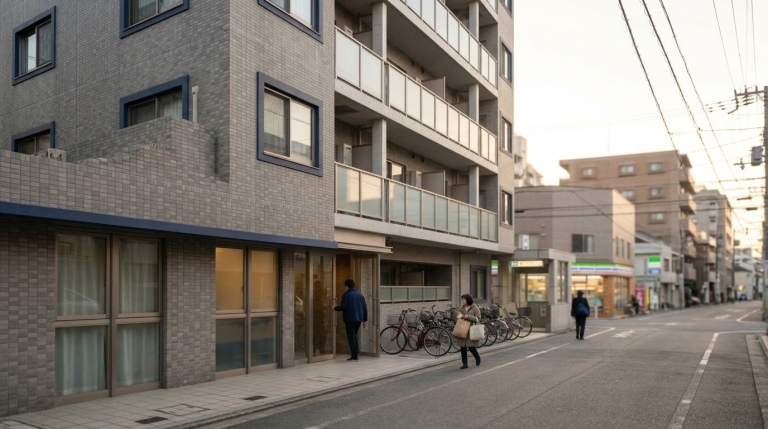
In Japan, “multi-family” typically means a small residential building — usually 2 to 4 floors, wooden or light-steel construction — with anywhere from 2 to 12 individual units. These aren’t skyscrapers. They’re the kind of modest buildings you walk past every day in Osaka or Fukuoka without thinking twice.
The budget range? Up to around ¥100 million — approximately $640,000 USD at current May 2026 exchange rates (USD/JPY hovering around ¥155–157). That’s your sweet spot for getting into a building that gives you real flexibility without the maintenance headaches that come with larger structures requiring elevators.
NTI Insight Ziv’s rule of thumb: stick to 3 floors or fewer under a ¥100M budget. Once you hit 4 or 5 floors without an elevator, top-floor units become hard to rent. If your building reaches 6 floors, Japanese law requires an elevator — which drains your yield with maintenance costs unless the building is large enough (8–9 floors minimum) to absorb them. Mixed unit sizes — studios on lower floors, larger family units above — give you the most flexibility and the widest tenant appeal.
Why Multi-Family Over a Single Condo Unit?
This is the question we hear most often. If you can buy a condo in Osaka for ¥5–8M, why tie up ¥60–100M in a whole building? Three words: control and flexibility.
You Own the Land and the Structure
When you own the entire building, there’s no owner’s union (管理組合) telling you what you can and can’t do with your units. Short-term rentals like Airbnb? As long as local zoning allows it, you can apply for a license. With a single condo unit, the owner’s union almost always prohibits short-term stays — and 99% of them would never change that rule.
You Can Run Multiple Income Strategies in One Asset
One building can operate across multiple income strategies simultaneously. Long-term residential tenants on lower floors. An Airbnb unit upstairs. A commercial tenant — a small law firm or accounting office that prefers residential-style spaces. You can test, adapt, and pivot without selling the asset.
Some NTI clients purchase buildings with tenants already in place — all units on long-term leases. As tenants move out one by one, they convert select units to short-term stays, monthly rentals, or commercial use. The risk is spread. The experiment is low-cost. And if a unit doesn’t perform on Airbnb, converting it back to a standard lease takes minimal effort.
You Can Live There Too
Plenty of NTI clients purchase a building, use one unit when visiting Japan, and rent the others year-round. That combination is extremely difficult to structure legally in a strata building where you don’t control the rules.
What Net Yields Can You Realistically Expect in 2026?
These are net pre-tax figures — after purchase costs and all known running and management expenses, before annual taxes. This is how Ziv and NTI quote yields, and it’s the only honest comparison point.
| Location | Typical Net Yield | Notes |
|---|---|---|
| Central Tokyo / Central Osaka | 3–4% | Strong capital gain potential; low yield trade-off |
| Suburban Osaka, Saitama, Yokohama | 5–6% | NTI’s preferred sweet spot for yield + growth balance |
| Fukuoka & regional hubs | Up to 6–6.5% | Strong fundamentals; buy near station or transport hub |
2026 Market Update Osaka purchase prices have risen sharply — metro property prices climbed roughly 16% year-on-year in 2025, which has compressed entry yields on newly listed properties. Deals still exist, but the window for easy finds is narrower than 12 months ago. Moving quickly when the right property surfaces is no longer optional — it’s essential.
How does 5–6% compare to an S&P 500 index fund at 7–8%? It’s not either/or. Real estate in Japan gives you geographic diversification, yen-denominated assets at historically weak levels, and an asset you can use, adapt, and leverage — none of which a stock index provides. The investors who perform best hold both.
NTI Insight — The Yen Advantage in 2026 The yen remains historically weak — sitting around ¥155–157 to the USD as of May 2026. That’s still well below the ¥110–115 range of 2021–2022, representing a 30–40% currency discount for USD, AUD, and GBP buyers converting today. The Bank of Japan has moved rates cautiously upward, and most analysts expect gradual normalisation rather than a sharp reversal — meaning the window likely persists through 2026, though it may narrow. Buyers who’ve been watching should be acting.
Which Cities Are Worth Targeting Right Now?
Foreign investment in Japanese real estate hit a multi-year high in Q1 2026, with transactions up 18% year-on-year. Competition is real. Here’s where NTI is focusing — and why.
Osaka — Still the top pick despite being a crowded market. Deals move fast. If you can authorise quickly without waiting on time-zone delays, this is where you want to be watching.
Saitama City — 30 minutes to central Tokyo, prices still moderate relative to the access. An underrated and under-competed market for multi-unit buyers.
Yokohama — Stick within 4–5 stations from the port centre for the strongest and most stable tenant base.
Fukuoka — One of Japan’s best-performing investment cities. Less of a bargain than it was 10 years ago, but demographic fundamentals — young population, growing tech sector, international gateway city — keep yields attractive at up to 6%+ on well-located small buildings.
Kyoto — Few multi-unit buildings come to market (most available stock is townhouses and single-family homes). But when a small building surfaces, it’s worth acting on immediately.
NTI’s core location rule: within 10 minutes’ walk to a train station for smaller studio and couple-sized units; within reasonable distance to parking for family-sized units. For secondary cities, target the regional capital or a city within an hour of a major metro hub.
Can Non-Resident Foreigners Get a Loan?
Yes — but with conditions. Officially, loans for non-residents must be for long-term residential lease purposes. Short-term Airbnb financing isn’t available through conventional lenders. The path that works for most NTI clients involves three steps.
First, set up a Japanese corporate entity (KK or GK — kabushiki kaisha or godo kaisha). Second, appoint a Japanese resident as representative director — a service NTI and similar companies can facilitate. Third, apply for financing through that corporate structure.
It adds a layer of setup, but it opens the door to leverage — which changes the return math considerably. Don’t assume financing is out of reach before speaking to us. Book a call and we’ll walk you through what’s realistic for your situation.
How Does Property Management Work for a Whole Building?
This is where multi-unit diverges most from single-condo investing. You’re not just managing a tenancy — you’re managing a structure. Annual fire safety checks, structural maintenance, and building-wide decisions are all yours to own.
Finding the Right Manager
For buyers in Japan who speak the language, internet reviews are the starting point. Read landlord reviews, not tenant ones. A property manager described as “too strict” by tenants is often exactly what a landlord wants. Landlord reviews flagging late payments or poor reporting? Walk away.
For non-residents: in every major Japanese city, there are English-friendly property management companies that handle long-term residential buildings. For short-term stays, English-speaking operators exist in Osaka, Tokyo, Fukuoka, and Sapporo. For more rural or secondary markets, NTI can act as your Japan-based proxy — providing a local face, a Japanese bank account for rental deposits, and a point of contact who handles issues in real time.
What Fees to Expect
The industry standard for ongoing management is 5% of gross rental income plus consumption tax (5.5% total). There is no legal mandate, but this is what the market runs on. You’ll also pay 1–2 months’ rent as a placement and advertising fee each time a new tenant fills a vacated unit.
Rural or low-competition markets may charge 7–10%, but there’s no evidence of meaningfully better service at those rates — stick to 5% operators wherever possible. And if you grow to a portfolio of 7+ units managed by the same company, a rate of 3–4% is negotiable.
Mixed-Use Buildings (Long-Term + Short-Term)
Running both long-term tenants and an Airbnb unit in the same building requires either a single management company experienced in both — which takes more hunting to find — or two managers coordinating through you. It’s workable. NTI can help structure this from the outset so it doesn’t become a headache later.
What Are the Real Risks?
No pitch here. These are the challenges to understand before you commit.
No owner’s union means no financial safety net. There’s no reserve fund. No one is going to maintain the structure for you. You must set aside cash from rental income for structural maintenance, fire safety compliance, and emergency repairs.
Cash flow discipline matters more than with a single unit. When rental income is ¥300,000–500,000/month, it’s tempting to remit it all home on a recurring schedule. Don’t. Keep a local buffer in Japan so that unexpected repairs don’t force expensive emergency international transfers at bad rates.
Vacancy risk is yours alone. Unlike a condo unit where a bad month is low stakes, a vacant floor in a small building hurts. Location discipline at the point of purchase is your best protection.
Overseas “experience” can backfire. Japan’s real estate rules, tenant protections, and market dynamics are different from Western markets. Clients who assume Japan works the same way often run into avoidable problems. Come in with an open mind, not a playbook from another country.
Seasonal fluctuation on short-term rentals is real. If you run Airbnb units, expect seasonality. Build your financial model around conservative occupancy estimates, not peak-season numbers.
NTI Insight — The Investor Mindset The clients who do best in multi-unit aren’t necessarily the most experienced real estate investors — they’re the ones with an investor mindset. They expect fluctuation. They don’t panic when something needs fixing. They think in 10-year time horizons. If this would be your first-ever investment and represents your entire life savings, build your investor instincts first on something smaller. Educate yourself on what real investment looks like before you scale up.
Frequently Asked Questions: Multi-Family Property in Japan
Can foreigners buy apartment buildings in Japan?
Yes. There are no restrictions on foreign nationals purchasing real estate in Japan, including multi-unit buildings. Non-residents can also access financing by setting up a Japanese corporate structure with a resident representative director.
What is a good net yield for a multi-unit building in Japan?
In suburban Osaka, Saitama, Fukuoka, and similar cities, 5–6.5% net pre-tax yield is achievable. Central Tokyo and Osaka typically offer 3–4%. NTI targets 5%+ for all client acquisitions.
How much do I need to invest in a multi-family building in Japan?
Entry-level multi-unit buildings can start from around ¥30–50 million depending on location and condition. More desirable 6–12 unit buildings in strong locations typically fall in the ¥50–100 million range (approximately $320,000–$640,000 USD at May 2026 rates).
Can I run Airbnb in a multi-unit building I own in Japan?
Yes, if local municipal zoning permits it. You’ll need to obtain a short-term rental license. Unlike condo units — where owner unions almost universally prohibit short-term stays — owning the entire building gives you the right to apply for a license on your own terms.
What’s the best city to buy a multi-unit building in Japan right now?
As of May 2026, Osaka remains the most competitive market with strong demand and capital appreciation. Saitama City offers good value with proximity to Tokyo. Fukuoka continues to perform for yield-focused buyers. NTI recommends staying within 10 minutes of a major train station in any market.
Do I need to speak Japanese to invest in property in Japan?
No. NTI has been helping English-speaking foreign investors buy and manage Japanese real estate since 2012 — entirely without requiring Japanese language ability. We handle the language barrier for you.
Is real estate investing experience required?
Not specifically. Most NTI clients have never purchased in Japan before, and overseas experience can sometimes be counterintuitive here. What matters more than experience is mindset — approaching it as a long-term investment, not a guaranteed monthly income stream.
The Bottom Line
Multi-family property in Japan is not passive investing. It’s active ownership of a real asset in a market that remains significantly undervalued against major currencies — with real yields, real tenants, and real optionality that single-unit condo investing simply can’t match.
Three things to take away from this guide:
1. The currency window is still open. With USD/JPY at ¥155–157 as of May 2026, foreign buyers still hold a meaningful price advantage. That window won’t stay this wide indefinitely.
2. Location and structure discipline matter more than anything else. Stay within 10 minutes of a station, stick to 3 floors or fewer under ¥100M, and target markets with real tenant demand — not just low prices.
3. Get your financial ducks in a row before you start. Have capital plus reserves. Know you’re locking it in for the medium to long term. Build your local buffer and don’t drain it back home every month.
NTI has been sourcing, structuring, and managing Japan real estate for foreign buyers since 2012. If you’re ready to explore what a multi-unit building could look like for your portfolio, let’s talk.
Ready to Explore Multi-Unit Investment in Japan?
Book a free 30-minute consultation with the NTI team. No scripts, no pressure — just honest answers from people who own property here themselves. Book a Free Consultation