
Investing in Japanese real estate? Here’s what you need to know about rental yields.
Rental yield measures how much income a property generates compared to its cost. In Japan, the gross rental yield averages 4.34% (as of Q3 2025), but net yields are typically 1.5% to 2% lower due to taxes, management fees, and other expenses. Major cities like Tokyo and Osaka offer lower yields (around 3.59% and 3.34%, respectively) but boast high occupancy rates (95%+), while regional areas like Fukuoka and Sapporo provide higher yields (4.98%) with more risk.
Key Points:
- Gross vs. Net Yield: Gross yield excludes costs; net yield reflects actual profitability.
- Operating Costs: Annual expenses range from 20%-35% of rental income.
- Regional Variations: Tokyo offers stability; smaller cities provide higher yields but face higher vacancy risks.
- Taxes: Non-residents face a 20.42% withholding tax on rental income but can claim deductions through annual tax filings.
- Due Diligence: Verify income, expenses, tenant stability, and natural disaster risks before investing.
Whether you’re targeting steady income or higher returns, understanding these factors is crucial for success in Japan’s real estate market.
How to Calculate Rental Yields in Japan
Gross Rental Yield vs. Net Rental Yield
In Japan, property listings often display the gross yield (表面利回り or hyoumen rimawari), also known as “surface yield.” This is a straightforward calculation: divide the annual rental income by the purchase price and multiply by 100. Here’s the formula:
(Annual Rent Income ÷ Purchase Price) × 100.
On the other hand, net yield (実質利回り or jisshitsu rimawari) provides a clearer picture of profitability by accounting for annual operating expenses and acquisition costs. The formula for net yield is:
[(Annual Rent Income − Annual Operating Costs) ÷ (Total Purchase Price + Acquisition Costs)] × 100.
Operating costs in Japan typically include building management fees (kanri-hi), repair reserve contributions (shuzen tsumitate-kin), property management fees (usually around 5% of the monthly rent), fixed asset taxes, and insurance premiums. As a general rule, net yields in Japan’s property market are about 1.5% to 2% lower than the gross yields advertised.
Next, we’ll explore how metrics like the cap rate and payback period can provide additional insights into property performance.
Cap Rate and Payback Period
The cap rate measures the net annual return on your investment. To calculate it, subtract all recurring costs from the rental income, then divide the result by your total investment, including acquisition-related taxes.
The payback period estimates how many years it will take to recover your initial investment through net cash flow. When calculating this, use realistic occupancy rates rather than assuming full occupancy. For example, in many major cities outside Tokyo, occupancy rates typically range from 93% to 94%. Be sure to also account for tenant turnover costs, as these can impact your cash flow.
Yield Calculation Checklist
When analyzing rental yields, keep this checklist in mind:
- Gross vs. Net Yield: Confirm whether the advertised yield is gross or net. If it’s not specified, assume it’s gross.
- Rental Income Details: Check if the listed rental income includes items like parking fees or water bills, as these may not continue with future tenants.
- Market Rents: Recalculate yields using market-average rents, especially if the current tenant’s rent is above market rates.
- Conservative Estimates: Use cautious assumptions for vacancy rates and expenses. Also, verify the repair reserve fund to avoid unexpected costs.
These calculations provide a solid foundation for evaluating property income potential, setting the stage for a deeper dive into income assumptions in the next section.
Reviewing Property Income Assumptions
Carefully analyzing income assumptions is key to refining rental yield estimates in Japan’s diverse real estate market.
Checking Rent and Occupancy Rates
To ensure rental income projections are accurate, verify that the stated rents exclude transient fees already accounted for in yield calculations. Some property listings might include additional fees that aren’t guaranteed for future tenants. It’s also wise to compare the current rent to local market averages for similar properties. If rents are above the market rate, they may drop when the current tenant moves out.
“A current tenant may be paying higher than average rent if the market average dropped… if a tenant that is paying too high leaves, you will be forced to lower the rent closer to the market average.” – Nippon Tradings International
Occupancy rates are just as critical as rental figures. Properties located within a 10-minute walk of a train or subway station tend to experience fewer vacancies. Additionally, the type of lease can influence income stability. Ordinary leases give tenants strong renewal rights, making rent increases challenging, while fixed-term leases allow for more flexibility in rent adjustments but often start with lower initial rents.
Next, consider how property type and rental duration influence income patterns.
Multi-Unit and Short-Term Rental Income
When evaluating multi-unit buildings, remember to account for staggered vacancies across units rather than assuming full occupancy at all times. Tenant turnover fees – typically ranging from 0.5 to 2 months’ rent – can also affect cash flow and should be factored into your calculations.
Short-term rentals, while potentially offering higher nightly rates, come with additional costs such as frequent turnovers, cleaning, and platform fees. These expenses, combined with vacancy gaps and management overhead, often result in annual income that falls below that of traditional long-term rentals, unless purchased, managed and run in a very professional, short-term stay oriented manner – which is an art-form, a science, and a very bandwidth consuming endeavour!
Regional Income Differences
As of the latter half of 2025, average yields varied significantly by region. Fukuoka and Sapporo offered yields of 4.98%, while Tokyo and Osaka averaged lower returns at 3.59% and 3.34%, respectively. Properties in central Tokyo, despite their lower yields (around 3.33% for studio apartments), typically offer better liquidity and stability.
Japan’s property market is often categorized into investment tiers. Tier 1 cities like Tokyo and Fukuoka generally yield up to 4-5%. Tier 2 cities, such as Sapporo and Nagoya, offer higher returns of 5-7%, while smaller Tier 3 towns can reach even higher yields – on paper. However, higher yields in regional areas often come with increased risks, such as higher vacancy rates and reduced property liquidity. When evaluating properties in these areas, it’s essential to research local factors like university enrollment trends, corporate relocations, and infrastructure developments that could influence long-term rental demand.
Costs and Taxes in Japan
Understanding the various costs and taxes involved is crucial for accurately calculating net rental yields. While gross yields might seem appealing at first glance, the reality of property ownership includes numerous expenses that can significantly reduce your returns.
Purchase Costs
When buying property in Japan, upfront costs go beyond the purchase price. You’ll need to account for the Realtor commission/s, Real Estate Acquisition Tax, Registration and License Tax for transferring the title, and Document Stamp Tax, which depends on the contract value. Additionally, consumption tax applies to the building portion of the purchase (not the land) and to professional fees like agent and legal commissions (and it’s wise to budget for a judicial scrivener to handle registration tasks). If the property is vacant, professional reports on structural or soil integrity are often recommended.
Annual Operating Costs
Annual operating costs typically fall between 20% and 35% of rental income. Key expenses include:
- Fixed Asset Tax: 1.4% of the property’s assessed value, which is usually around 70% of the market price (reduced rate for structures under 200 sqm).
- City Planning Tax: Up to 0.3% in urbanized areas.
- Property Management Fees: About 5% of the monthly rent.
- Building Management Fees and Repair Reserves: In newer Tokyo builds, these average around ¥30,000 (approximately $200) per month.
Additional costs arise when a tenant moves out. These include “Advertisement” (AD) fees, which range from 0.5 to 2 months’ rent to attract a new tenant, and a “New Agreement Administrative Fee”, typically equal to one month’s rent, paid to the property manager. Don’t forget mandatory fire insurance, recommended earthquake insurance, landlord insurance, and expenses for repairs or restoration between tenants.
Tax Rules for Foreign Investors
For non-resident investors, a 20.42% withholding tax on gross rental income applies, especially when using a property manager or leasing to corporate tenants. However, this initial withholding is not the final tax amount. By filing an annual tax return through a Japanese tax accountant, you can deduct various expenses such as depreciation, property taxes, management fees, and insurance premiums, and receive a refund due for any withholding tax paid, once you settle your annual tax return statement
Nils Herchenroeder from Tokyu Housing Lease Corporation clarifies:
In most cases, you can get a portion of the withholding tax back, so for most owners the effective tax rate will be much lower, since income tax is based on the net profit.
Starting in 2024, non-resident property owners are also required to appoint a “Domestic Contact” – usually their property management company – to handle official government notifications and tax bills.
With these costs and tax obligations in mind, it’s important to evaluate how they impact overall market performance and potential risks.
sbb-itb-15a157d
Market Benchmarks and Risk Factors
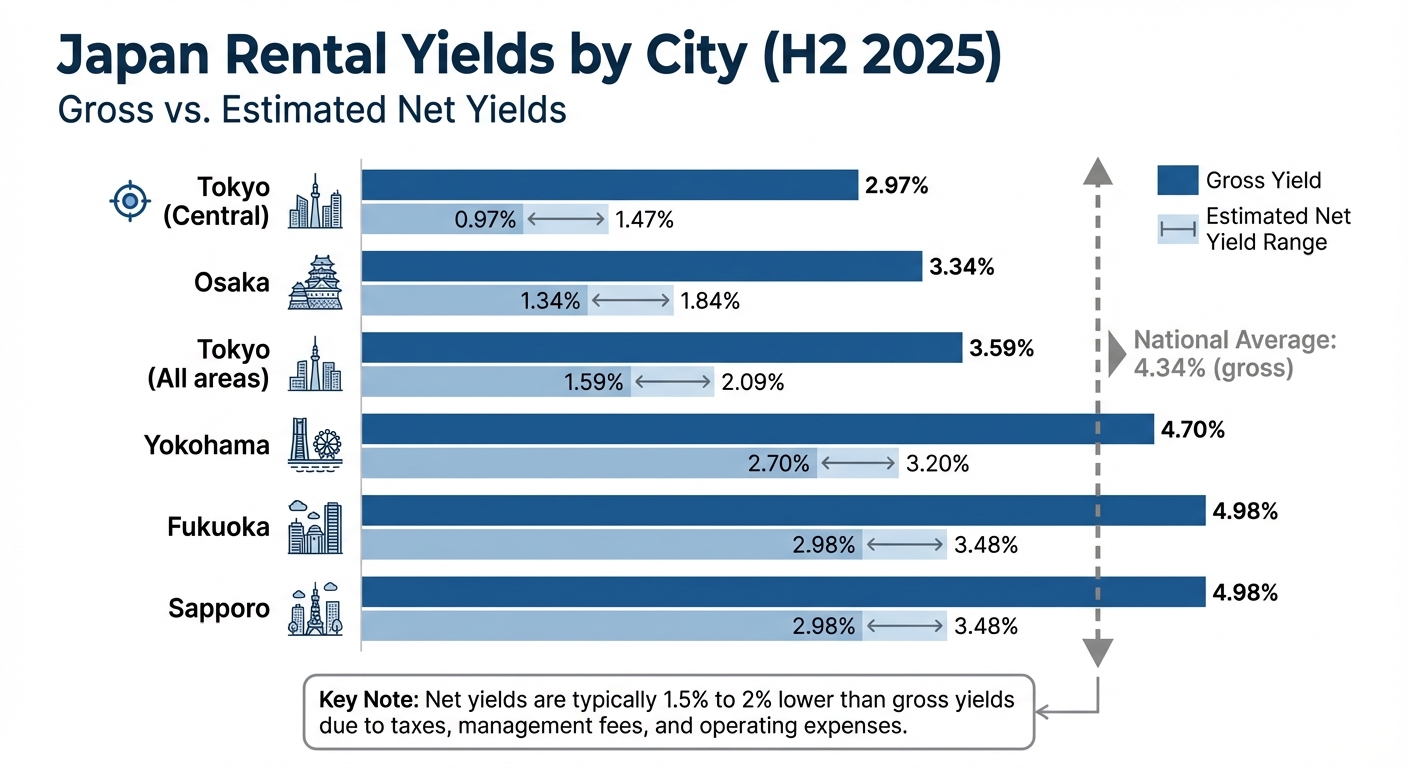
Japan Rental Yields by City: Gross vs Net Returns Comparison 2025
Comparing Yields to Market Standards
Once you’ve nailed down the costs, the next step is to see how your property’s potential yield stacks up against current market averages. As of Q3 2025, the average gross rental yield in Japan was 4.34%. That said, this figure can vary widely depending on the region, and property selection, both of which play a critical role in shaping your investment approach.
Take Tokyo, for instance. Properties in Central Tokyo tend to offer lower gross yields but greater stability. In H2 2025, Central Tokyo averaged a modest 2.97% gross yield, while properties across all Tokyo locations averaged 3.59%. On the other hand, cities like Fukuoka and Sapporo delivered 4.98%, Yokohama came in at 4.70%, and Kobe at 4.48%. Keep in mind that gross yields are generally 1.5% to 2% higher than net yields, as net yields account for taxes and operating expenses discussed earlier.
| City | H2 2025 Gross Yield | Estimated Net Yield |
|---|---|---|
| Tokyo (Central) | 2.97% | 0.97% – 1.47% |
| Tokyo (All areas) | 3.59% | 1.59% – 2.09% |
| Osaka | 3.34% | 1.34% – 1.84% |
| Yokohama | 4.70% | 2.70% – 3.20% |
| Fukuoka | 4.98% | 2.98% – 3.48% |
| Sapporo | 4.98% | 2.98% – 3.48% |
Another important factor is property age. Older properties often yield higher gross returns across all regions and property types. This is largely because they compensate for the higher maintenance risks and potential depreciation. The building type also makes a difference: “Apato” (wood or light-gauge steel structures) usually offer better yields than “Manshon” (reinforced units in concrete buildings) due to their higher price, which dictates lower purchase costs percentage-wise. However, they might demand more maintenance over time.
Once you’ve analyzed the yields, it’s time to dive into property-specific risks that could influence your returns.
Property and Tenant Risks
Beyond comparing yields, individual property characteristics can significantly affect your returns. One of the most critical factors is location. Properties with consistently high occupancy rates and low delinquency rates tend to provide more stable returns.
The building’s condition is another key consideration. Check if the reserve fund for major repairs is sufficient and whether recent renovations – such as roof repairs, exterior upgrades, or elevator maintenance – have been completed. Neglecting these details can lead to unexpected costs, as previously highlighted in the discussion on maintenance reserves and taxes. Tenant stability is also crucial; properties with long-term tenants often indicate reliable, steady income.
Lastly, don’t overlook Japan’s natural disaster risks. Always consult local government hazard maps during your due diligence to evaluate risks like earthquakes, tsunamis, or landslides. Properties built after 1981 adhere to stricter earthquake standards, but given Japan’s seismic activity, earthquake risks remain a factor to consider.
Due Diligence and Professional Support
Conducting Due Diligence
Once you’ve identified a property with promising returns, it’s time to dig into the details. In Japan, due diligence happens only after your offer is accepted. The market moves fast, and real estate agents typically don’t provide comprehensive information upfront. If your due diligence uncovers issues – like problematic tenant history, insufficient renovations, or inadequate reserve funds – you can still withdraw your offer before signing any contracts – but make sure you note the condition for review of the building’s investigation report on any offer you make, to avoid offending the listing agent and seller by simply pulling out without advance notice – or they won’t work with you (and potentially with all other foreigners) again, as this is considered unprofessional in Japan, and you’ll be labelled a tire-kicker.
“One of the quirks about the Japanese real estate market, however, is that the due diligence is only conducted once your offer is accepted.” – Nippon Tradings International
Start by verifying the financials. Check that income figures exclude one-off fees. Then, review the legally required “Explanation of Important Matters” (Juyo Jiko Setsumeisho). This document outlines key details such as the owner’s title registration, ownership type (freehold or leasehold), and contract cancellation terms.
Pay close attention to the building’s reserve fund (sinking fund). A low fund balance might be acceptable if the property has undergone recent major renovations, like roofing, exterior painting, or elevator upgrades. These large-scale projects typically occur every 10–15 years, so review the building’s history to anticipate future expenses. Additionally, confirm that the property complies with the 1981 Building Standards Act for earthquake resistance. Properties built after 1981 adhere to modern safety codes, but older buildings may require retrofitting.
For tenanted properties, examine tenant profiles thoroughly. How long have they stayed? Do they use a guarantee company to reduce the risk of rent defaults? If a tenant is paying above-market rent, you might see a drop in yield when they move out. For vacant houses, you have the advantage of conducting professional inspections, including checks on the structure’s condition and soil stability, at your own expense. Lastly, consult local government hazard maps to assess risks like flooding, tsunamis, or landslides.
This careful review process helps you identify potential red flags and ensures you’re well-prepared to move forward. Leveraging professional expertise can make these steps much easier.
How NTI Supports Your Investment
Navigating the Japanese real estate market from abroad can be daunting, but Nippon Tradings International (NTI) simplifies the process by acting as your local representative. They handle everything from negotiations to documentation, so you don’t need to travel to Japan.
“NTI is not a real estate agency. It’s actually a proxy service and a buyers’ agency… we’re a natural extension of anyone who wants to invest in Japanese real estate.” – Nippon Tradings International
NTI ensures every step of due diligence is thorough and aligned with industry standards. Their services include property sourcing, yield analysis, and detailed inspections. They verify all documentation, such as building history, financial records, tenant profiles, and reserve fund details, to confirm the listing’s accuracy and uncover any hidden costs. They also evaluate compliance with the 1981 Building Standards Act and assess whether the sinking fund is adequate for upcoming renovations.
After your purchase, NTI continues to provide property management and tax support. They communicate with tax authorities, insurance providers, and property managers on your behalf. If you don’t have a local Japanese bank account, NTI can act as your banking proxy, managing rental income and paying bills like taxes, insurance, and utilities. They also coordinate with leasing agents, handle tenant communications, and address maintenance issues, serving as your single point of contact. Standard property management fees are about 5% of monthly rental income, excluding consumption tax.
For first-time investors, NTI offers entry-level opportunities with properties priced as low as $25,000 to $30,000, including all purchase costs. For example, in late 2018, a Canadian client worked with NTI, to purchase their first property for $30,000, near public transportation, in a metropolitan area. The client prioritized low risk (post-1981 construction) and achieved a 5% net pre-tax yield. After this successful start, they expanded their portfolio with a $65,000 investment in a suburban area, targeting higher yields of 6-7%.
Conclusion
Assessing rental yields in Japan goes beyond simply looking at the advertised figures. To get a clear picture, you need to calculate net yields by subtracting management fees, taxes, repair costs, and insurance expenses from the gross returns. Keep in mind that advertised yields are usually gross and can be 1.5% to 2% lower once expenses are factored in. It’s crucial to confirm all income and expense details during the due diligence process.
It’s also essential to evaluate the financial health of the property. Look into the reserve fund balance and the building’s renovation history. Understanding tenant profiles can help you assess income stability, while consulting local hazard maps provides insight into potential natural disaster risks. These steps are vital for identifying potential issues, especially for foreign investors who may face additional hurdles.
For international buyers, NTI simplifies the process by addressing communication and logistical challenges. Acting as your local representative, NTI handles property sourcing, verifies due diligence, and manages post-purchase tasks like tax coordination. They also ensure listing accuracy and facilitate rental income remittances, so you don’t need a Japanese bank account.
This checklist provides a structured way to evaluate properties and calculate realistic returns. By combining detailed research with professional assistance, you can navigate Japan’s unique real estate market with confidence and build a portfolio that generates steady, long-term income. Use this guide as a starting point to secure dependable returns in Japan’s dynamic property landscape.
FAQs
What’s the difference between gross and net rental yields in Japan?
In Japan, gross rental yield is a straightforward calculation: take the annual rental income, divide it by the property purchase price, and multiply by 100 to express it as a percentage. However, this method doesn’t factor in expenses like taxes, property management fees, insurance, or the impact of potential vacancies.
In contrast, net rental yield gives a more precise look at profitability. It accounts for these annual costs by subtracting them from the rental income before dividing by the purchase price. This approach provides a clearer sense of the property’s actual financial returns. For investors, knowing both metrics is crucial for assessing the real performance of a rental property.
What should I consider when deciding between investing in Tokyo or other cities in Japan?
When looking at Tokyo compared to regional cities like Osaka, Fukuoka, or Nagoya, it’s essential to examine rental yields and property prices. Tokyo generally offers lower gross yields, averaging between 3% and 3.5%, but property values are significantly higher. On the other hand, regional cities often deliver yields above 4% and come with lower purchase prices, making them appealing for those aiming for better cash flow with a smaller upfront investment.
Next, think about occupancy rates and tenant demand. Tokyo boasts a strong, stable occupancy rate of over 96%, supported by a diverse tenant base that includes corporate workers and students. This creates a reliable income stream. Regional cities, while offering the potential for higher short-term returns, can be more vulnerable to local economic shifts or fluctuations in tourism.
It’s also critical to factor in taxes, management fees, and currency risks. Acquisition taxes, annual property taxes, and management fees can eat into your net yields by a few percentage points. If you’re converting rental income to U.S. dollars, shifts in the yen’s exchange rate could further influence your overall returns.
For tailored advice, Nippon Tradings International (NTI) can assist in navigating these factors, helping you balance yields, costs, and risks to align with your investment objectives.
How can non-resident investors handle taxes on rental income from Japanese properties?
Non-resident investors earning rental income from properties in Japan face a withholding tax of 20.42% on their gross rental income. This amount is automatically deducted each year and acts as a prepayment toward your final income tax bill.
To handle your taxes more efficiently:
- File an annual tax return: When filing, you can subtract eligible expenses like property taxes, maintenance fees, and management costs. These deductions often reduce your overall tax rate and may even lead to a refund of the withheld amount.
- Consult a tax professional: Japan’s tax rules can be challenging, especially for non-residents. A knowledgeable tax advisor can guide you through deductions and help you take advantage of tax treaties, such as the U.S.-Japan tax treaty, to lower your tax burden.
NTI provides tax and accounting services tailored to foreign investors. They assist with tax filings and partner with licensed tax professionals to ensure you meet Japanese tax requirements while maximizing your investment returns.


