
Foreigners can buy property in Japan with the same rights as Japanese citizens, including land and buildings. There are no restrictions based on visa status, and ownership is freehold. However, challenges like language barriers, financing complexities, and legal documentation can make the process tricky without proper guidance.
Here’s a quick roadmap to help you navigate the process:
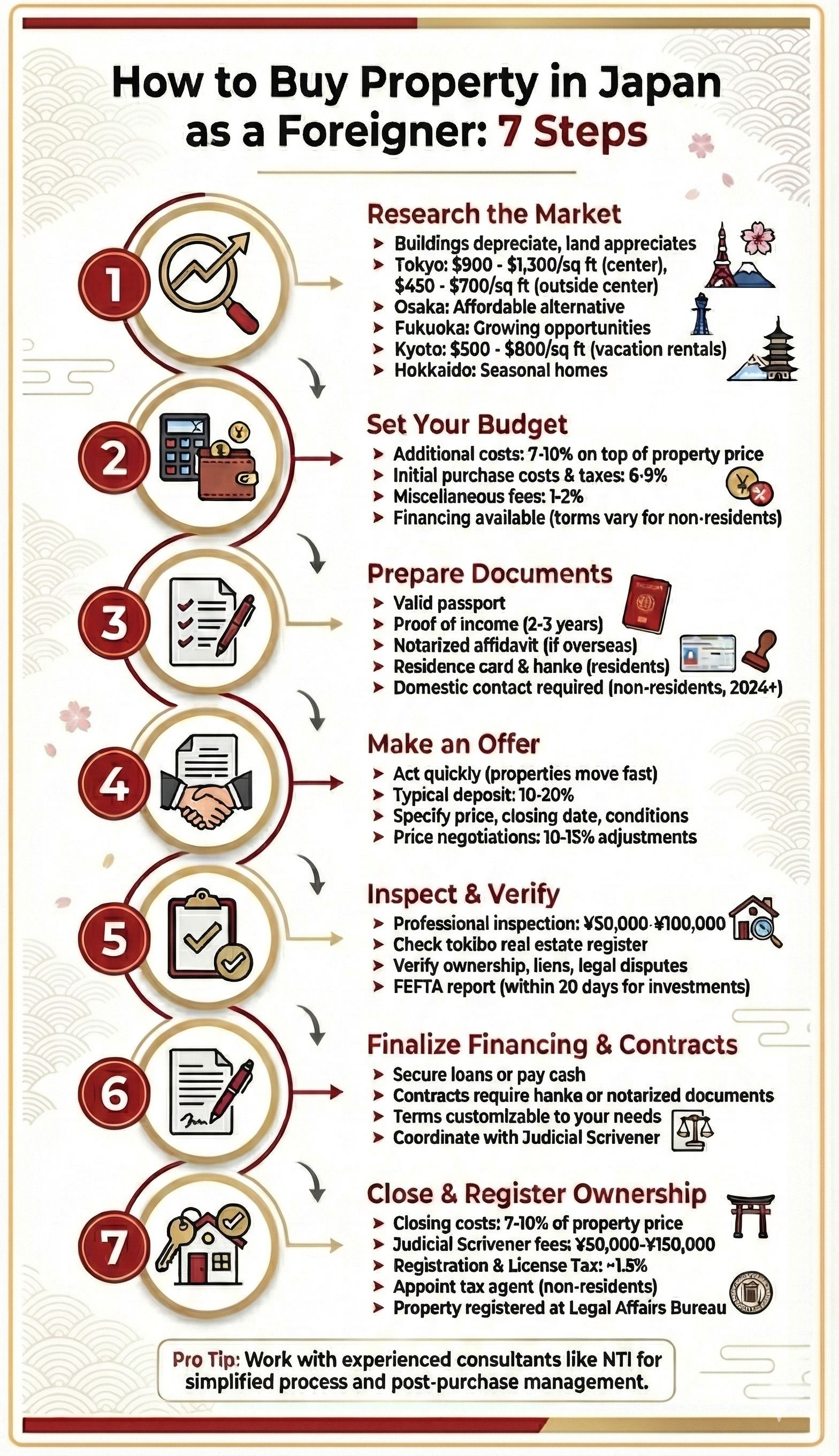
- Research the Market: Understand that land appreciates while buildings depreciate in Japan. Popular locations include Tokyo (high prices, strong rental market), Osaka (affordable with good yields), Fukuoka (growing opportunities), Kyoto (ideal for vacation rentals), and Hokkaido (seasonal homes).
- Set Your Budget: Account for 12–18% in additional costs (taxes, fees, services). Financing is available, but terms vary for non-residents.
- Prepare Documents: Gather essentials like a passport, proof of income, and notarized affidavits. Non-residents may need a domestic contact or tax representative.
- Make an Offer: Submit a formal offer quickly, as properties move fast. A 10–20% deposit is typical.
- Inspect & Verify: Conduct professional property inspections and legal checks. Ensure ownership and zoning compliance.
- Finalize Financing & Contracts: Secure loans or pay in cash. Contracts require a personal seal (hanko) or notarized documents.
- Close & Register Ownership: Pay closing costs (5–18%), transfer ownership, and register the title. Appoint a tax agent if needed.
Pro Tip: Work with experienced real estate consultants like Nippon Tradings International (NTI) to simplify the process, especially for legal and post-purchase management.
With the right preparation, buying property in Japan is straightforward and accessible.
Step 1: Research the Japanese Property Market
Before diving into Japan’s property market, it’s essential to understand how it works. In Japan, buildings generally lose value over time, while land tends to gain value, especially in sought-after areas. This means that when you invest, you’re primarily banking on the value of the land rather than the structure itself.
Market trends can vary widely depending on the location. For instance, in 2023, property prices in central Tokyo saw a significant rise due to the demand for urban, multifunctional living spaces. Being aware of these trends will help you set realistic goals and make informed decisions.
It’s also crucial to note that regulations differ from one region to another. What applies in Tokyo might not hold true in cities like Osaka or Fukuoka. Taking the time to research these variations can save you from unexpected hurdles and help you accurately plan for taxes, fees, and other costs. This foundational research is key to identifying the best locations and property types that align with your investment goals.
Popular Locations for Foreign Buyers
Tokyo remains the top pick for foreign investors, thanks to its position as Japan’s economic powerhouse. Property prices in Tokyo’s city center average about $10,093.72 per square foot, while areas outside the center are priced at roughly $5,206.28 per square foot. The city’s strong rental market and potential for land appreciation make it an attractive, though premium, investment.
Osaka offers a more affordable alternative, blending its vibrant cultural scene with lower property costs. Investors are drawn to Osaka for solid rental yields without the hefty price tag associated with Tokyo. Fukuoka is gaining attention for its affordable living costs and expanding business opportunities, making it a rising star for both residential and commercial buyers. Kyoto, famous for its tourism appeal, is ideal for those targeting vacation rentals like Minpaku, with average property prices around $5,444.58 per square foot. For seasonal vacation homes, Hokkaido is a popular choice, especially among those seeking properties in scenic, snowy settings.
When choosing a location, prioritize properties in major cities with strong growth potential. These areas not only offer better resale opportunities but also provide consistent rental income, making them ideal for long-term investments. Once you’ve narrowed down your location, the next step is aligning your property choice with your financial goals.
Property Types and Investment Goals
Japan’s property market offers a range of options tailored to different investment strategies. Residential properties, such as apartments (often referred to locally as "mansions") and detached houses, are the most common choices for foreign buyers. Apartments in urban centers are popular for their steady rental income and relatively low maintenance, while detached houses offer more space but come with higher upkeep costs.
Commercial properties can deliver higher returns but require more active management and a deeper understanding of the market.
Your investment strategy should guide your property selection. For steady rental income, look for apartments in established neighborhoods. If you’re aiming for higher returns through vacation rentals, consider properties in tourist-heavy areas like Kyoto or Hokkaido. Alternatively, properties in developing regions near planned infrastructure projects may offer opportunities for long-term value growth.
For those who prefer a hands-off approach, Real Estate Investment Trusts (REITs) offer a way to diversify and gain exposure to the market without directly owning property.
Step 2: Assess Your Finances and Budget
Before diving into the Japanese property market, it’s crucial to get a clear picture of your financial situation. If you’re a foreign buyer, be prepared to budget an additional 12–18% on top of the listed property price. This extra amount covers costs like currency conversion, translation services, and international banking fees. You’ll also need to account for initial purchase costs and taxes, which typically range from 8–10%, along with miscellaneous fees that can add another 3–9% – and in some cases, even up to 10–15%. Understanding these expenses upfront is key to planning your purchase effectively.
Estimating Costs
One often-overlooked expense is appointing a tax representative, which is a legal requirement for foreign buyers. Because fees can vary widely depending on your specific situation, working with local experts is highly recommended. They can help you calculate a detailed budget and ensure you’re not caught off guard by unexpected costs. Having an accurate estimate of all expenses will help you choose a property that fits within your financial plan. This is especially important if you are considering buying a holiday home in Osaka as an investment.
Financing Options for Foreigners
Once you’ve nailed down your budget, it’s time to explore financing options. Foreigners are allowed to purchase property in Japan and can apply for housing loans, but the terms and eligibility requirements differ depending on your residency status. If you’re a permanent resident, you’ll have access to better loan terms and a wider range of financing options, as Japanese banks tend to view permanent residents more favorably. Non-permanent residents, on the other hand, often face stricter conditions, such as higher down payment requirements and the need to prove a stable income. If loans aren’t an option or seem too restrictive, paying in cash can simplify the process – though it demands a significant amount of capital upfront.
Step 3: Gather Necessary Documents
Getting your paperwork in order is a crucial step when buying property in Japan. The good news? Foreigners can purchase property in Japan without needing citizenship or residency. However, the exact documents you’ll need will vary depending on whether you’re a resident or purchasing from overseas.
Documentation Checklist
First and foremost, you’ll need a valid passport for all signings and registrations. If you’re overseas or unable to present your passport in person, an affidavit will be required. This document confirms your name, address, and signature, and it must be notarized either in your home country or at your country’s embassy or consulate in Japan.
For those applying for a loan, lenders typically ask for proof of income covering the past 2–3 years. This could include tax returns, bank statements, or a Gensen-Chōshū-Hyō (a Japanese income statement). Residents living in Japan for three months or more will also need a residence card, a personal seal (hanko), and a Certificate of Seal Impression (Inkan Tōroku Shōmeisho) issued within the last three months. Non-residents, on the other hand, can use a Signature Certificate from a Japanese consulate or notary, which doesn’t have an expiration limit.
Starting in 2024, non-residents without a Japanese address must designate a domestic contact. This could be a relative, a trusted real estate agent, a friend, or a legal professional. If you’re unable to attend the transaction in person, a Power of Attorney (Ininjo) can authorize someone to act on your behalf, but it must be properly notarized and legally executed. You’ll also encounter documents like the Jūminhyō (Residence Certificate) from your local municipal office and the Tōhon (Certificate of Ownership) from the Legal Affairs Bureau, which confirms ownership of the property.
These documents are the backbone of your purchase process, setting the stage for negotiating terms in the next step.
Legal and Tax Considerations
Gathering documents is just one part of the process – you’ll also need to address legal and tax requirements. Japan’s property registration laws mandate compliance, with the Real Property Registration system keeping records of property conditions and ownership rights. If you’re living abroad, it’s highly recommended to appoint a domestic tax agent. This ensures your tax obligations are managed efficiently, and important bills don’t get lost. Additionally, if you’re a non-resident purchasing certain commercial properties or large-scale investments, you must report the transaction to the Ministry of Finance through the Bank of Japan within 20 days, as required by the Foreign Exchange and Foreign Trade Act (FEFTA).
To navigate these requirements smoothly, it’s wise to work with experienced professionals assisting foreign buyers – such as the consultants and proxies at NTI. They can help you avoid missteps and ensure the process goes as smoothly as possible.
Once your documents are in place, you’ll be ready to move forward and start negotiating your offer.
Step 4: Make an Offer and Negotiate Terms
Act quickly when you’re ready to make an offer – properties in Japan can disappear from the market within hours or days. Your offer should clearly outline the price, closing date, and any conditions.
Making an Offer
Your broker will handle the submission of your offer using a standardized form provided by the agency. On this form, you’ll need to specify key details, including your proposed price, the desired closing date, and any conditions, like financing contingencies, inspection requirements, or timelines for reviewing documents. If you’re a non-resident paying in cash, be sure to highlight this. Cash offers are highly appealing to sellers as they avoid the delays associated with bank approvals.
"It is important to note that the market in Japan moves extremely fast, and attractive deals can be gone in a matter of days, and in some cases, within hours from listing." – Nippon Tradings
You may also want to include conditions such as information on renovation history, reserve funds, or tenancy details. These allow you the flexibility to withdraw or renegotiate if any issues surface. Being aware of common mistakes when buying Japanese real estate can help you identify these issues early. Once your offer is accepted, you’ll sign a Commitment to Purchase, while the seller signs a Commitment of Sale to officially take the property off the market. Typically, a 10% deposit is required, but offering 15–20% can make your offer more appealing, especially if the seller needs quick access to funds.
With your offer submitted, the next step is to navigate the negotiation process.
Negotiation Strategies
Negotiation in Japan often requires a more subtle approach compared to Western markets, particularly in areas like Central Tokyo. Price adjustments are usually modest, often no more than 10–15%, and should be backed by specific reasons. These might include factors like a first-floor location, absence of an elevator for higher floors, outdated earthquake standards, distance from the nearest station, or the need for noticeable renovations. Rather than direct verbal discussions, negotiations are typically conducted through written offers submitted by your agent, which is considered a more respectful method in Japan.
Having loan pre-approval in place can strengthen your position during negotiations. Agencies like NTI can assist by managing communications on your behalf and navigating cultural nuances. If a price reduction isn’t possible, consider negotiating for additional benefits, such as included furniture or other concessions. Keep in mind that for non-residents, the full documentation process can take about six weeks if you’re not in Japan, or roughly four weeks if you’re already familiar with the process.
sbb-itb-15a157d
Step 5: Conduct Due Diligence and Property Inspections
Once your offer is accepted, the next step is making sure the property lives up to your expectations – both physically and legally. This process is crucial for protecting your investment from potential structural issues, legal complications, or hidden problems.
Property Inspections
Bringing in a professional building inspector is a must to uncover issues that might not be apparent during a casual walkthrough. In Japan, home inspections are still gaining traction compared to practices in Western countries. However, changes to the Building Lots and Buildings Transaction Business Act in April 2018 made it mandatory for sellers to discuss the option of home inspections during transactions. Further updates in 2024 introduced stricter disclosure rules aimed at boosting interest in pre-owned homes.
A licensed inspector will conduct both visual assessments and detailed checks using specialized equipment. Basic inspections typically cost between ¥40,000 and ¥70,000, depending on the type of property. More detailed assessments could cost double that amount. Keep in mind, though, that basic inspections often exclude plumbing, drainage systems, and water supply checks, which can usually be added for an extra fee.
You’ll need the seller’s consent to carry out an inspection, so ask your agent to arrange this. For condos or apartments, you might also need approval from the building’s management association if shared areas are part of the inspection. If you’re a foreign buyer, working with an agent who can connect you with an inspector offering English-language services is highly recommended.
Once you’re satisfied with the property’s physical condition, the next step is to verify its legal status.
Title and Legal Checks
Checking the property’s legal standing is just as important as inspecting its physical condition. In Japan, property details are recorded in the tokibo real estate register (登記簿), maintained by the Legal Affairs Bureau. This register contains key information such as ownership, location, characteristics, and any registered rights like mortgages or liens. You can access the tokibo or request a certified copy for a small fee, ensuring transparency and ownership verification.
To ensure everything is in order, hire a judicial scrivener to review the real estate register. They will confirm the property’s ownership, check for any liens or legal disputes, and verify that the seller is the legitimate owner. Before signing any purchase agreement, ask for a thorough explanation of the "Explanation of Important Matters" (重要事項説明書/Jūyō Jikō Setsumeisho) from a licensed real estate professional.
Foreign buyers face additional steps to comply with local regulations. If you’re purchasing property for investment purposes, you must file a post-acquisition report under Japan’s Foreign Exchange and Foreign Trade Act (FEFTA) within 20 days of the purchase. This applies to non-residents buying commercial properties, large-scale investments, or second homes, but it usually doesn’t apply to properties intended as personal residences. Moreover, if the land is classified as "agricultural" or "forest", you’ll need special government approval before proceeding.
Step 6: Finalize Financing and Sign Contracts
Once your inspections and legal reviews are complete, it’s time to secure financing and sign the necessary contracts. In Japan, contract practices are quite flexible, allowing terms to be tailored to fit your specific needs. This step ensures that clear, actionable agreements are in place.
Signing Contracts
Contracts in Japan are highly customizable. They outline the key details of the transaction, including pricing, specific terms, and the responsibilities of both parties. For instance, sellers are obligated to transfer ownership, while buyers are responsible for paying the agreed amount.
Instead of handwritten signatures, Japan uses a personal seal, known as a hanko. If you’re purchasing remotely, you’ll likely need notarized documents or a power of attorney to complete the process. Local professionals can provide valuable guidance to ensure everything is handled correctly.
Role of NTI in Purchase Facilitation

NTI simplifies the process of securing financing and signing contracts. Acting as your central point of contact, they coordinate with local experts to manage documentation and legal requirements, making the process as smooth and efficient as possible.
Step 7: Close the Deal and Register Ownership
Once you’ve secured contracts and financing, it’s time to finalize your purchase. Closing day is when everything becomes official: you’ll complete a final property inspection, transfer ownership, settle any remaining payments, and register the title under your name. A Judicial Scrivener (司法書士/Shihō Shoshi) plays a crucial role during this process. They verify your identity, confirm that funds are in place, and ensure all documentation is accurate and complete at the Legal Affairs Bureau.
Closing Costs and Tax Payments
Closing costs in Japan generally fall between 5% and 18% of the property’s price. If you’re a foreign buyer, additional expenses typically range from 12% to 18% due to extra services. These costs include the remaining balance of the sales price, pro-rated property taxes, and various fees. For example:
- Judicial Scrivener fees: ¥50,000–¥150,000 ($330–$1,000)
- Registration & License Tax: Around 1.5% of the assessed property value
Additionally, you’ll need to budget for the real estate acquisition tax, which is billed 3 to 12 months after the purchase. Real estate agent commissions are typically paid at closing as well.
Ownership Registration
The Judicial Scrivener handles the ownership transfer application by submitting it to the Legal Affairs Bureau. If you’re not in Japan, this process can often be managed remotely. Their responsibilities include reviewing all documents, ensuring the title is clear, and registering the property in your name. For non-resident foreign buyers, it’s wise to appoint a local tax agent to handle annual fixed asset and city planning tax payments. U.S. citizens should also report the property, along with any rental income or capital gains, on their U.S. tax returns. You can take advantage of foreign tax credits to offset these obligations. Once this is done, you’ll have officially transitioned from buyer to owner.
Post-Purchase Management
To protect your investment and ensure compliance, consider using property management services. Companies like Nippon Tradings International (NTI) provide extensive post-purchase support. Their services include coordinating maintenance, managing tenants, paying utility bills, and handling ongoing tax compliance. Whether you’re renting out the property long-term or exploring short-term leasing options, these services help keep your investment in great shape and financially compliant.
Conclusion
Foreigners enjoy the same rights as Japanese nationals when purchasing property, but navigating the process demands attention to local legal and financial details. Following the seven outlined steps ensures a secure and smooth transaction.
Proper preparation can help overcome challenges like language barriers, unfamiliar regulations, and differences in practices. Begin by setting a realistic budget that accounts for not just the purchase price but also additional costs like taxes, fees, and potential renovations. Gather all required documentation early, thoroughly inspect the property – including checks for structural soundness and earthquake resistance – and confirm ownership history and zoning rules before making any commitments. These steps lay the groundwork for successful negotiations and a seamless ownership transfer.
For added convenience, consider working with experts like NTI. They handle everything from documentation to post-purchase services, offering support in areas such as property sourcing, due diligence, tax compliance, and tenant management. Their expertise helps foreign investors navigate the complexities of the Japanese property market with confidence.
Finally, keep market trends and challenges in mind when planning your long-term strategy, whether you aim to rent out or resell the property. With careful planning and professional guidance, you’ll be well-prepared to invest wisely and grow your portfolio in Japan.
FAQs
What legal requirements should foreigners know about when buying property in Japan?
Foreigners can purchase property in Japan without any special permits or residency requirements. For most real estate types, there are no restrictions. However, buying farmland or forested areas might require government approval, and certain limitations apply to land located near military bases or U.S. military zones.
After completing the purchase, it’s essential to register the property in your name and take care of the necessary taxes. These include the property acquisition tax and the annual fixed asset tax. Understanding these responsibilities upfront can make the process much smoother.
What are the differences in financing options for foreign residents and non-residents when buying property in Japan?
Financing options in Japan differ quite a bit for foreign residents compared to non-residents. If you’re a foreign resident – especially a permanent one – you’ll find that many lenders treat you similarly to Japanese citizens. This means you could qualify for mortgage loans with lower interest rates, longer repayment terms (sometimes stretching up to 35 or even 50 years), and in some cases, little to no down payment is required. Of course, the exact terms will depend on the lender.
For non-residents, the situation is more challenging. Loans often come with higher interest rates, shorter repayment periods, and larger down payment requirements – sometimes as much as 50% of the property’s value. On top of that, you’ll usually need to prove a stable income, and some lenders may even ask for Japanese language proficiency. While certain banks specialize in working with international clients and offer tailored loan options, these often come with stricter conditions to meet.
What factors should I consider when choosing a location for property investment in Japan?
When considering property investment in Japan, there are several critical factors to weigh before making a decision:
- Accessibility: Properties close to train stations or public transportation hubs often see higher rental demand, making them a popular choice for tenants.
- Local amenities: Areas with easy access to shopping centers, schools, parks, and hospitals are highly sought after, as they offer convenience and a better quality of life.
- Future growth potential: Neighborhoods slated for urban development or redevelopment projects can offer promising opportunities for property value appreciation over time.
- Zoning and regulations: Be sure to review local zoning laws and land-use restrictions to confirm the property aligns with your investment objectives.
- Natural disaster risks: Evaluate the property’s safety in relation to earthquakes, flooding, and other potential natural disasters. Earthquake-resistant structures are especially important in Japan.
- Costs: Compare property prices, taxes, and maintenance fees across different areas to ensure they fit within your budget.
By thoughtfully assessing these factors and aligning them with your overall investment plan, you’ll be better positioned to choose a location that balances profitability with long-term stability.


